Context: what is described here is the academy's teaching model, not a consensus of professional societies and not a proven causal chain. It describes what professionals learn to observe and test during the training.
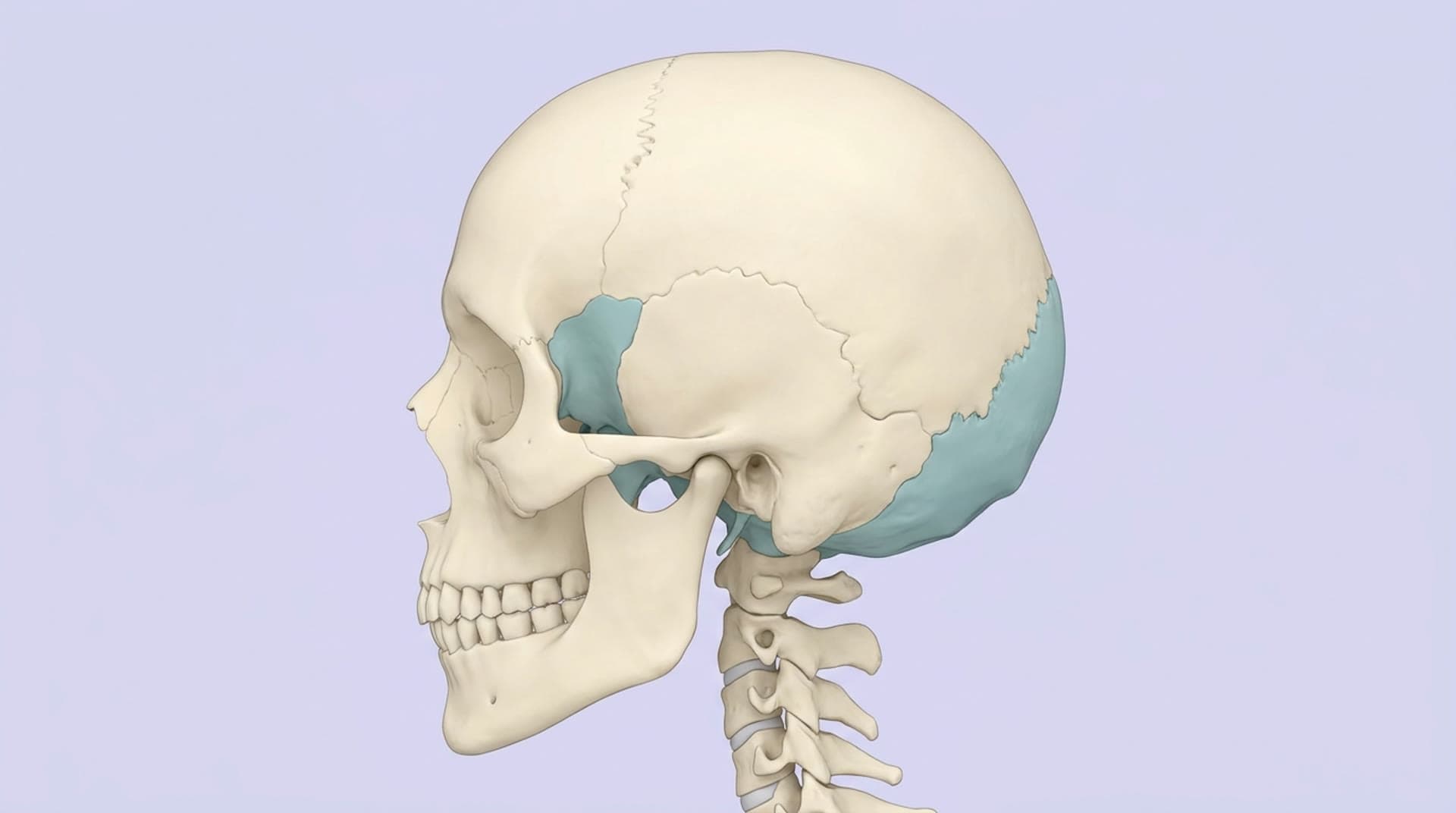
Two bones at the centre of the skull
At the centre of the skull lie two bones that matter in this model: the sphenoid (os sphenoidale) and the occipital bone (os occipitale). The other bones of the skull align to the sphenoid.
In front of the spine the two meet, at the spheno-basilar synchondrosis, SBS for short (often called the spheno-basilar symphysis).
When the base is not neutral
If these two bones are not in a neutral position, the model holds that the upper and lower jaw no longer relate correctly either. The cause can be trauma, a difficult birth, or the base simply grew that way. This displacement is called cranial strain.
In this picture the malocclusion is not the origin, but what you see of it at the teeth.
Why moving teeth leaves the base unchanged
Orthodontics moves teeth and guides the jaws into a position. The displacement at the skull base stays where it was. That is not a criticism of orthodontics but a different question: orthodontics asks where the teeth should be. This model asks why they are where they are.
It is also how the model explains why some patients only notice jaw-joint problems long after orthodontic treatment: the teeth are ideally aligned, but the joint still has to compensate for the position of the base.
Where dentosophy starts: with the muscles
The chewing muscles attach exactly to these structures. Through the balancer and a balanced chewing pattern, the aim is for them to guide the bones back towards balance, with the bite changing along with them, especially in growing children. Add the functions: tongue rest posture, nasal breathing, swallowing pattern.
In adults, relaxation comes first. The muscles have to let go before they can learn anew. A splint does not train muscle; it decouples the bite.
Expansion is not the same
A narrow jaw is often expanded mechanically. If the base is displaced, the model suggests that expansion can open on one side only or add tension. That is why the training reads the base first and decides afterwards.
From the skull base to posture
The spine starts at the skull base, and posture hangs from the spine. That is why posturological tests with the balancer are part of the teaching: they show, case by case, how bite, head position and body statics interact.
What you learn in the training
You learn the landmarks that reveal the position of the skull base in a face, how to test it on the patient, and how to plan from there, always within the scope of your own professional licence.
“We dentists always look at the teeth. I want you to look at the skull, because that is where the problem is.”